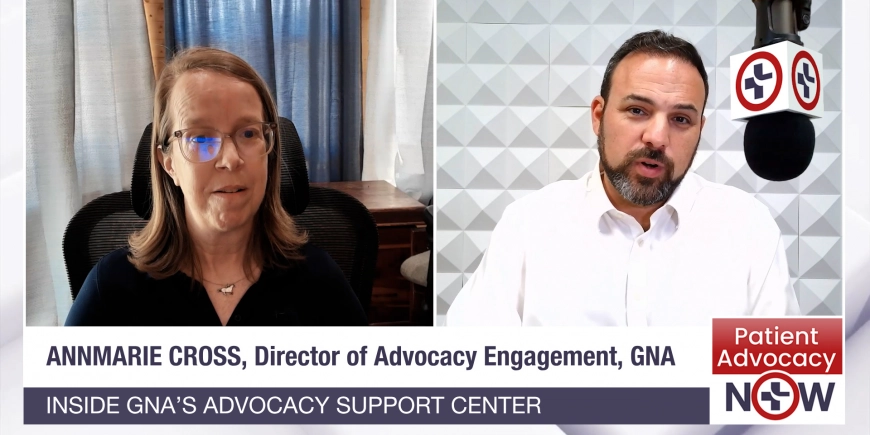

When Patients Get Stuck: Inside GNA’s Advocacy Support Center
Greater National Advocates has expanded beyond its patient advocate directory with the launch of the Advocacy Support Center, a free service designed for patients and families who don’t know where to turn. AnnMarie Cross explains how the support center has grown from taking occasional calls for help has evolved into a structured support system with 24/7 live intake, personalized resource research, and curated advocate matching
Through real cases from an ICU patient facing an unsafe discharge, an elderly woman nearly forced from her home over lawn care, and a grandmother unable to access medical care because she lacked a walker, AnnMarie shows how seemingly small barriers can derail an entire healthcare journey. She also explains how advocates can use the center for difficult cases and optimize their GNA profiles so their specialized expertise is easier to find.
Transcript:
Host
I'm here with Anne-Marie from Greater National Advocates, who is going to talk about the official launch and awareness campaign here about the Advocacy Support Center on the Greater National Advocates website. So, Anne Marie, talk to me about why this was created. What happened before the Advocacy Support Center? Before we even get into what it is, what was the impetus behind it?
Annmarie Cross
Yeah.
So from the very first day that GNA had the directory, you know, there was a phone number tucked somewhere on the bottom edge of a contact page. And we would get calls from family members and loved ones that would say, you know, I don't know how to use the site or I can't find what I need. And someone at GNA would find time to try and take care of that scenario. And we have some pretty amazing stories of really helping people, but not as a structured program, just as a, this is a side piece of what we do.
Host
Right. So essentially we were a directory and people were leaving phone, you know, phone messages and we're like, okay, well we gotta get back to these people. So what has it evolved into now?
Annmarie Cross
So we're really proud of the program now that it is a fully structured support center. You know, we are using a structured process to get intake information from the patient. We've got staff members that are really developing complex information back to answer these questions people are bringing us, no matter what the scenario is that they need. We're trying to really reach out and fill whatever the gap is that they're needing.
Host
So I I assume that the thinking behind it was you'd get more calls like, Hey, I'm trying to navigate the website. Is that what it has become or has it kind of expanded from there?
Annmarie Cross
That's where it started, or at least kind of what it looked like when I was first being involved with it, but it has grown so much farther than that. you know, those calls might be, you know, my dad was just diagnosed with ALS and I don't know what to do. Well, we're not gonna just give them a couple of names and phone numbers. We're also going to connect them to nonprofits about ALS. We're gonna help them find a caregiver support group in the area because they might not know they need it, but they're going to. And then we're going to give them a curated list of advocates that have that knowledge for whatever that condition is.
But it's also stretched into everything from people with complex social determinants of health needs, so food insecurity, housing insecurity, people with equipment needs, all the way to, you know, real emergency scenarios.
Host
Do have any interesting case studies of an example of a bit more of an emergency issue that kind of came through?
Annmarie Cross
I do. So one of the first times I was helping out on a weekend was on Memorial Day weekend. And on a Sunday afternoon I get a phone call from this woman that her mom is in an ICU in the middle of nowhere, up somewhere in the northwest, has been hospitalized for 96 days, and the discharge planner has called her on Sunday of a holiday weekend to say, we can no longer care for your mom. We don't have the facilities for her, and we can't find another hospital to take her. So please come pick her up tomorrow. Monday, Memorial Day.
Without any transportation, any DME, any step down, literally out of the ICU, put her in your car and take her home.
Host
Wow.
Annmarie Cross
In that sort of scenario, I can't just handle three advocates' phone numbers and go back to my burger. You know, so we're actually calling advocates, we're finding someone with the right knowledge who can help her today. and super proud of the outcome of that scenario that we got her in contact with two advocates within about two hours. The next day they had a plan in place to move her to another hospital on Tuesday. They got her through a proper step-down process and got her home. and that that woman tells anyone who will listen that the combination of G and A and those advocates are why her mom's still alive.
Host
Wow. Now you mentioned that you were pho manning the phones on the weekend. So is this a kind of round the clock support center? Is it manned, you know, by actual live people? What are the hours? What does it look like?
Annmarie Cross
So our intake team is available 24-7, 365. What we promise is one to two business days turnaround that my internal team will actually be able to get detailed emails out, get returned calls made. We're typically much faster than that, but we're a small team and sometimes there may be lags. So that's what we normally promise. But if something is really urgent, we do have people trying to keep an eye on that and responding in those really urgent cases.
Host
I think it's incredible that you have a twenty four seven intake team. At least someone calls and could talk to a human, not an AI bot, or just get lost online. Because a lot of people, especially with certain populations, you know, who aren't as literate online, might be just in the weeds and not know where to go and want to talk to a person.
Annmarie Cross
And for a brief time when we started this, we were using just a voicemail instead of using an intake team. And more than 50% of people just hung up and didn't leave us a message. And they just, you know, they want to talk to a live body. They don't know if anyone's ever gonna hear this thing. And so they just wouldn't leave a message. So we made that commitment to have a full-time intake team.
Host
Yeah,
Host
And do you find that there are people who use it that you weren't necessarily expecting to use the service?
Annmarie Cross
Absolutely. so much of what we get are complex, unusual things that you don't even think of as being barriers to healthcare. My favorite example of that is I got a an an intake message that the heading of it said lawn care services.
And I was just coming off of a really difficult ticket and I had that reaction. I kind of laughed. I was kind of like, what are you giving me? What do you mean lawn care services? Well, it was an 80-year-old lady living in the house she was literally born in. I think she had MS, if I remember correctly, could no longer afford to pay for her gardener, and the property around hers had actually been taken over, it could and you know, merged into a an HOA.
Host
Is it?
Annmarie Cross
And the HOA was fining her for not doing her lawn care. Ironically, more than her gardener had cost her, what and the amounts they were fining her. And she was thinking about moving into a nursing home not because she needed nursing home care, but because the HOA was basically gonna force her out of her property.
Host
It was
Annmarie Cross
Turns out there are national nonprofits that will low them on will mow the lawn for elderly folks or folks with severe disabilities. And we were able to connect her with one of those. They got a contract on file that the HOA has a copy of. The HOA removed all the letters from her records. And she's not only able to stay in her home, but now making sure that like downed tree limbs and those sorts of things are taken care of for her.
Host
Wow. Yeah, that's something you wouldn't expect at all from from one of the service center calls. What about other advocates? How how are they using the service?
Annmarie Cross
Yeah.
Annmarie Cross
So we're we're really trying to encourage our other advocates to use the service as a way that we can provide them whatever support they need.
So whether what they need is they got a call that's wildly outside of their skill range, that certainly happens. instead of just telling that person, hey, go back to the website and try again, they can have them call us directly. They can even do a warm handoff. They can call my team, give some background of what the call's about, and then have us call that potential client and get the information and help them get where they're going. we can help them find resources for clients that they're that they're working with that, you know, they just can't find the right resource in the area. Well, we can use our tools to help them do.
Yeah.
Host
Yeah, that's a heck of a resource, especially if there's if it's just a portion of a case that they don't understand, you know, not not understand, but don't have an expertise in, they can kind of partner up, which a lot of advocates do in different ways. So you're you're it's it's taking the matchmaker service of G and A kinda to a new level in terms of making sure people are put in the right place.
Annmarie Cross
Absolutely.
Annmarie Cross
That and that's exactly what we're trying to do and trying to fill those gaps. And sometimes the gaps are just so different than than what you might expect. sometimes the call is wildly narrow, John, and so the patient can't possibly match on their own on the website. an example of
Host
Well,
Host
Right. Right. Unless they really unless they're really digging in and reading everybody's bio six times and they don't have time for that kind of stuff. Sure, sure. Makes sense. How do how do people actually I'm sorry, go ahead.
Annmarie Cross
Right. Yeah. when we started we would spend up to an hour.
When we started working on doing these matches, sometimes it would take us as much as an hour, even an hour and a half, to curate that narrow list and say these are the advocates that really meet that need.
You know, an example was a pediatric case that the child has type 1 diabetes, was hospitalized because of an acidosis episode, but also was post a prior episode of sepsis. And the father felt like the doctors were just ignoring the septic piece of how that was impacting what she was going through. And we were actually able to find three advocates in our database with pediatric knowledge, with extensive diabetes knowledge, and with clear understanding of sepsis and hospital-bound infections.
Host
Wow. How how have you gotten that sped up? I know you said that it used to take you an hour, hour and a half. How have you guys improved over time in terms of the efficiency?
Annmarie Cross
So we're using PIPA compliant medical grade AI to help us do searches and bring us starting points so that then our team can spend their time working at the top of license and making sure we're making the right pairing and the right matches, rather than spending all of our time, like you said, combing through thirty or fifty profiles trying to find a a good connection.
Host
Seems like there's a lot of work that's gone on under the hood to kind of make this a more seamless process for both back end and for speed for the the end user.
Annmarie Cross
Absolutely. My team jokes that every day is kind of like Christmas morning. You get to unwrap the tool and see what we changed yesterday. You know, we're always looking for what can save them time, what can make sure our answers are more accurate, what can get the right resources in front of patients as fast as possible.
Host
And how do people actually utilize the center? Is it just the toll free number that that instigates it? Is there another way to use it?
Annmarie Cross
So on the website, there are multiple places where we give them tags that say things like get free guidance. those will bring them to a landing page for the support center. Then on the support center, they can either use the 888 number or there's also an intake form that they can use that asks them essentially the same questions that the intake staff would ask. and that way, you know, we can get that information in digitally directly.
Host
Mm-hmm.
Host
So whether they're whether they're using the form or they're using the the intake team that's a live person on the phone twenty four seven, it gets imported into some kind of an electronic system on your back end. So that's why you're you're able to work so quickly. You have the data, you could pass it from person to person and kind of comb it against what's available and who'd be the best fit. Is that right?
Annmarie Cross
Right.
Annmarie Cross
Right, exactly. Yeah. and and we also have a team of advocate volunteers that help support my group as well. That's part of how we're able to continue to grow the skill set and the services that we're offering. And so that same backend tool, we've really tried to build that in a way that a volunteer doesn't even have to tell me they're available. You have a free hour and you're trained. You can step in and say, this is a call I'm comfortable returning the call on, pick up that work and get client contact out that much faster.
Host
And people can still contact the advocates directly. So if I'm on the directory and I find someone who I think is a fit, I still get their phone number, I still get their email ability and things like that. This is just if they're lost and they need some help. It's just another asset so they don't continue feeling lost. They they can get a little personal help. Is that right?
Annmarie Cross
That's exactly right. Yeah, none of the directory has changed at all. on the homepage now there are kind of twin buttons. One is search immediately, one is get guided get some free guidance so that we can help them figure out, you know, what they're looking for. But yeah, this is yeah, this is a second kind of of our of our three pillars. The first is the the directory.
The second is this as the advocacy support center. And then the third on the advocate side is the patient advocacy 360 tool. They'll give advocates a place to talk to each other. So those are our three nonprofit resources.
Host
That makes sense. If I'm an advocate on the directory and I want to optimize myself for certain specialties so that when someone calls the center or is in touch with the support center, how can I further optimize my profile so that you guys know like that's my specialty, you should be calling.
Annmarie Cross
Great question. We actually did a blog post on this about a month ago. There's an area on the profile that is labeled as additional skills, but that's a great place to put keywords that help the search engine do its job. And that's a place where you can literally make a list of if you work with mast cell patients, tell me mast cell and also the abbreviation. If you work with, you know, CKD3, give me that abbreviation and also the term that the patient might be using. And that will help. If they're doing their own search, it helps to some extent, but especially if it's a complex.
Search that's using my my deep dive tool that really helps me find the patients that I can make or the advocates that I can connect for those patients.
Host
And is there like a a character limit or anything or they can stuff that in with every specialty they have essentially?
Annmarie Cross
They can there isn't a character limit. The file is pretty huge. The the drawback, the nurses that always struggle with this when I talk to them are like the folks that have been an ICU nurse or they've been a traveling nurse, and they're like, but I've done everything. and what we suggest to them is give me the specialties you've worked in. So tell me cardiology, tell me neurology, tell me, you know, neurooptho.
But then, as far as the keywords of the actual conditions, give me the ones that are really your sweet spot. Give me the ones that if you and I were sitting over a table together and I said, I have this kind of patient, you'd be like, I've done that. I have done diabetes education. You know, I have done heart transplants. Please reach out to me for those. and then other times the patient might be a complex patient where what I need is someone who knows cardio and GI and you know, musculoskeletal or whatever it might be.
then that's where those kind of broad skill set advocates can be really helpful.
Host
And is it a good idea to also put in like your demographics that you're used to working with? So if you have special experience with the senior population or with, you know, adolescents or things like that, that's also something that you could put in the keywords?
Annmarie Cross
Absolutely. And it's something, especially talking about adolescent and pediatric, we don't have enough advocates that I know have those specialties. They might, but they're not clear enough in their profiles. We also encourage things like, you know, what communities do you work with? Do you work with LGBT plus? You know, do you work with stigmatized conditions, such as certain mental health conditions? Please tell me that, because we are always working hard to find folks to support those patients.
Host
Okay.
Host
Yeah. So the more fringe and specialized your experience is, the more important it is to kind of highlight that in that section because there's a a shortage often of that kind of stuff in the directory. Okay. Makes sense. And so it's live and up and running now. There's nothing that people need to do. If they want to use it, they they can use it. If they want to direct their, you know, clients to it, they can. and it's just live and up and everybody needs to know about it essentially.
Annmarie Cross
Right. Yeah, exactly.
Annmarie Cross
Everybody needs to know about it, absolutely. It's you know, we just want people to be aware, we want people to lean into the tool. You know, we're our our goal is to make to give better access to advocacy, and we feel like this is an important piece of that. actually I have one other story for you, John, if you don't mind, if we can figure out if it fits in.
Host
Okay. Well thank you. Yeah, for sure.
Annmarie Cross
Some of our cases are what we call elevator cases, or I'm sorry, escalator cases. And those are where someone is stuck. There's one barrier in the way that is stopping everything else they need. And so my example of this was this was last year I got called by a sweet older woman out on the East Coast, raising her two grandkids, and she needs a hip replacement. but what she's calling for is she wants help getting a scooter. And
Her Medicare doesn't her Medicare Advantage doesn't cover an advocate, so trying to get her the resources for that. But when we start talking and start digging in, she says, well, I can't go to my doctor to get a prescription because I have to go to his office. And I can't go to his office. And so, okay, what kind of explain things for me? Well, she needs a hip replacement, but doesn't even have a walker.
So literally when this grandma goes grocery shopping, she sends her grandkids down the hall. They borrow the neighbor's walker, who also can't get out of her house without walker. Scary. Bring the walker down to grandma, get grandma in the car, grandma drives to the store. If there's no cart at the store, grandma stays in the car and the 10-year-old is on the phone with grandma, walking through the store, doing the shopping, putting the stuff back in the car. So she's housebound because she doesn't have a walker.
And so we got her connected with a lending library that not only had a walker for her and loaned her a scooter for 60 days, but they actually sent someone to her house and brought her a walker and fitted her for a scooter and got her started. And we also got her information on paratransit. She didn't know anything about paratransit, so that she would have better access to get to her doctor appointment, so that she could then get, you know, get an actual script for a permanent scooter and get in to see her hip replacement doctor.
into all these downstream things, but she had a a literal physical barrier keeping her from getting the health care she needed.
Host
That's amazing. That's amazing. With the things we take for granted when we're healthy, right? Amazing. Yeah, because the doctors there not realizing, she probably can't get out of her house. and I have 10 minutes until I have to see my next patient. So just come in and see me anytime, and we'll get you a prescription. It doesn't work that way.
Annmarie Cross
Right. Yeah.
Annmarie Cross
Right.
Annmarie Cross
Right, exactly. And no, I'm not gonna see you on telehealth. I haven't seen you in X amount of time. I wanna actually check your, you know, your blood pressure and things. He wants to do his job. But I'm sure between two receptionists and three nurses, he's never hearing the fact that, well, she can't get to his office.
Host
Yeah. And that's where the support center steps in. Okay. All right. Anne Marie, thank you so much. Everybody should take a look at it and try it once so they see how efficient it is. It's really quite impressive. Appreciate you letting us know about it.
Annmarie Cross
Right.
Annmarie Cross
Thanks so much for the time, John.
Host
Yeah.