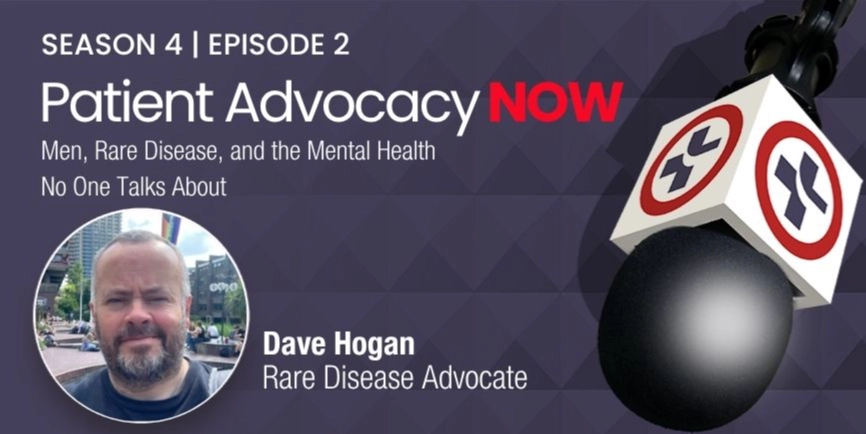

Men, Rare Disease, and the Mental Health No One Talks About
This episode explores the often-overlooked emotional and psychological toll that rare diseases take on men. The host speaks with Dave Hogan, a rare disease advocate who was diagnosed himself and later created a global support group specifically for men living with rare diseases or caring for loved ones who do. Dave shares how grief, isolation, and uncertainty after diagnosis pushed him to seek community, and why traditional support spaces often fail men who are expected to “just get on with it.”
The conversation covers why men are less likely to access mental health resources, how group dynamics help men open up, and the unique challenges rare disease creates in relationships, parenting, and identity. Dave also explains how his monthly online group works, who it’s for, and why flexibility and trust matter more than rigid structure. For men who feel alone navigating illness or caregiving, this episode is a reminder that support exists and connection is possible. To learn more or join the group, Dave can be reached directly at mensrarediseasemh@gmail.com.
Host
Dave Hogan, thank you so much for being on the podcast.
Dave
Hi Jon, thanks for inviting me.
Host
Absolutely. I wanted to talk to you specifically because one of the things that we don't get enough of an opportunity to talk about even on this podcast is the new reality that sets in after a diagnosis and the coping and the struggle that happens with that. Sometimes, you know, we're so caught up with the actual care, the medication, the procedures, making sure everything gets
kind of handled that very often we just neglect taking care of ourselves. And one of the groups that neglects taking care of their own mental health the most, which is where your kind of zone of genius and experience has, has been is with men. So talk to me about how this started for you, how you started this idea of doing men's specific groups and, and, and, and where it's at now.
Dave
Yeah, thank you, Jon, for that. So yeah, I was diagnosed with my condition in 2017 and my condition is called Kelden syndrome. It's something that affects everyone in 200,000 people. And it's something that for me was genetically passed on through my mother. When I was diagnosed, I was very much like
wow, what do I do next? How do I manage this? How do I, what does this exactly mean for me? And I think at that time, it was not long after my mother passed away from the same condition. So still grieving her and there was still an uncertainty about it all. So I feel for me, early on, it was very much a case of
finding out about this condition, connecting with a community that had it, although obviously there isn't many people that have it in the world, it was really important to find that support as well as education and awareness about my condition. So I started to do that and through that education awareness and connection, I was able to start looking at how to manage my health.
physically, as well as emotionally and mentally. And with that kind of, you know, that was a starting point for me in my kind of health journey.
Host
And so where did you get the idea to start the group and how did it actually come to be? Did you start locally? I know you have people who are kind of not so near you. So how did you spread the word? How did it grow?
Dave
Yeah, so I connected with my rare disease organization in the UK and the US and whilst I thought first that they're both doing fantastic work and important work but also B, kind of noticed there was amazing women whether that be patients or caregivers to children with the same condition as myself there wasn't many
males and I started to ask myself how could I kind of make a difference really to the lives of others impacted by this condition as well as myself and I decided to, so in 2020 June I decided to set up monthly zoom calls for males impacted by rare diseases around the world. I think my feeling was
very much kind of wanting to support anyone that felt they needed it and wanting to not leave out any men who felt alone, isolated with his condition. So from, from March, well from June in 2020, it's kind of, that was the first group meeting. We've had guys attend from six different continents proving
you know, despite different countries, cultures, social backgrounds, we have more in common with the emotional, mental and physical impact of living with these conditions. We've had speakers attend sometimes where they're sharing their stories and experiences, but other times we've had topics like being a parent, a father to a child with a rare condition or bereavement as another topic.
relationships. Relationships can be hard for men with rare diseases, common health conditions. And it's been amazing really to connect with amazing, a great bunch of guys who realise the importance of this area in, you know, in their lives.
Host
Why do you think there weren't as many resources for men available?
Dave
Yeah, yeah, that's a good question. I think I, I mean, I would say firstly, I think since when I started the group, obviously, that was around the time of the start of the pandemic. But I think things have changed in terms of more awareness resources. But I think, yeah, kind of, so it's not as
it's better than what it used to be. I still think there's work to go but back to that original first point I think men are expected to just get on with it they're not expected to share it's not natural for men to share their emotional feelings and the mental health side of living with a rare disease chronic health condition or life in general men are expected to toughen up and just get on with it. I also think as well
Host
Mm-hmm.
Dave
men are generally through their work. I think sometimes it's hard for men to kind of commit to kind of making the time. Some of the guys in the community that I'm connected to, they're busy with their full-time jobs as well as like being dads to children with rare conditions. And obviously there isn't a great deal of time. So, societal stuff. But I do think...
Like I said, the five years, five to six years, the world has changed a lot. And there's more awareness, of, and more resources for men. So I think we have made some steps forward as a globe, as a society.
Host
Yeah, it's nice to hear. Tell me your experience with men coming into the group. So I know that men are less likely or less conditioned to speak about their own emotional and mental health. Once they come in, do you find that they open up right away? Are they kind of slow to start? What's kind of typical in your experience?
Dave (07:43.2)
yeah, I've, this is something that is quite, it is quite interesting because I think whilst I, I still think it's not natural for men to share about, talk about the mental health. When they are together, you do find men do share more than what perhaps even I have expected with a thought in a group setting. I do think there are leaders who kind of.
get the conversations going and there are less quieter people but and it's something that I've kind of learned by experience the art of me being the facilitator is really to kind of make sure that that balance is heard so the less quieter folks kind of can get their chance to share and listen but they're not forced to to do that so I think men do share more
than what you'd think, but it needs to keep kind of in a group setting, like I said, kind of be balanced out, right?
Host
Makes sense. Makes sense. and your group, does it have specific parameters? So is it men who are born or not born, but kind of discovered they have kind of chronic conditions or life threatening illnesses or, know, how do you, how do you actually define who's a good fit for the group?
Dave
Yeah, yeah. So the group, it's male patients or caregivers living with a rare disease. I don't know, kind of in some countries, you know, the requirements for what rare disease isn't the same as like in another country, like sickle cell disease isn't a rare disease in Uganda, but it is in the USA.
So then, you know, I tried to, but I tried to get, you know, kind of the requirement, the parameters for men who have rare diseases and most 99 % of the time that's worked okay, because I think it's important for men who don't have a lot of resources, don't have treatments and cures for their rare diseases, you know, there's
I know that I know one guy who's attended a few times in the past who is one of 30 people in the world with an ultra rare condition. So that's always been really important for me to do that because I think the implications of living with a rare disease are different to someone who has Crohn's disease, for example. So it's important to kind of, you know, it is important to kind of give that space to the unheard voices should they
want to come and attend the group rather than kind of, and not only that, of other health conditions that men have to face, that they have more of a pool of resources compared to a rare disease that doesn't have… Yeah.
Host
Right.
Host
I think that makes perfect sense.
Host
It makes perfect sense. mean, you, you, it's a different journey. So if you have a rare disease and there's less resources and there's less treatment options and there's fewer people who actually even in the medical field understand the disease, you're hitting walls. There's different points of frustration that, you know, only people who have that rare disease experience can relate to. Whereas if you're, like you said, if you're dealing with Crohn's or colitis or something, and there's this huge community and lots of research,
It's different journey. It's just a different journey.
Dave
Yeah, exactly. Yeah. And it's so important for, for, um, I think as well, kind of like, whilst it, you know, there's arguments to bring in other men, you know, you could take the group off target, the original direction of where it's needed to go, you know, because, you know, it's like, we've talked about, it's not natural for men to talk about the mental health. Yeah, there may be arguments for that, but it's important to give that space to rare guys.
Host
Yeah, makes perfect sense to me. You mentioned that you also have people who are caretakers. Is that right in the group?
Dave
Yes, yeah. Yeah, we've...
Host
So that's beautiful. So even if they're struggling with the rare disease themselves, but they're taking care of their wife or a parent or a child with a rare disease, you're able to kind of empathize with that journey with people who have it as well as other caretakers, it sounds like.
Dave
Yeah, definitely. I think it's important to kind of acknowledge that being a caretaker still impacts you, but not in the same way as the patient. And it's important to, like some of these communities, rare communities, we don't have many other men in the community that come to the conferences or in the support groups. So I've always felt that's really, you know, that's kind of needed for what I do.
actually kind of as well it's been really powerful at times to hear and really moving to hear kind of caretakers sharing their experiences of looking after their children or you know in a few cases wife's partners. Yeah it's important to hear how it impacts them.
Host
And you mentioned relationships. If you, if you don't mind, I'd love to hear some of the challenges that we wouldn't know people who aren't struggling with rare disease, what that looks like, what, where some of those challenges are for men and how you've learned to navigate through some of that stuff.
Dave
Well, yeah, you know, I think this is something that really isn't kind of shared enough really. Certainly in the larger community, what I do and perhaps as a society, how men who are impacted by rare diseases, some of us are married or have partners, but some of us are single and the struggles around finding a partner and
sharing that I have this rare condition and you know it can be challenging to kind of being single and it's not an easy journey for some of the guys, some of the guys there's a lack of awareness around rare diseases, chronic conditions and also you know some of the guys have gone through surgeries and procedures in their bodies and you know and I remember kind of listening to one guy sharing about that and feeling you know
It was a moment where I forgot, I'm really glad I'm setting up this group for other people because that sounds difficult where you're kind of like, excuse me, being vulnerable with someone that you've just met and you would like it to progress and for it to be kind of, for it to be able to not move forward because of your health must be hard. And I'm so glad that I...
you know that's one of the many reasons why I'm so glad that I provide this space because it's not easy for guys to talk about these things naturally as well. You know the society expectation of men being macho and kind of going out there and finding partners you know so it's important for men to be able to be vulnerable about that if they need to.
Host
And how long have you been running your own group and how often does it meet? do you, know, tell me a little bit more of the details. How long does each group last? Is it an hour? Is it longer, shorter? And how often do you meet?
Dave
Yeah. So we meet once, once a month now, we used to meet twice a month, but if I'm being honest, it was a lot of work for me kind of managing my health. have a day job outside of what I do advocacy wise. So it's gone back to a month. but I actually really enjoying it more now. I've kind of stepped back a little bit. so yeah, it meets once a month, it's online on Google meets, and it's one hour long.
and it's at the end of, yeah, so it's the last Saturday of the month, 4 till 5 PM UK time. And people who would want to join would kind of register for an invite. So the format would be kind of like introducing ourselves and then kind of, it says a speaker, the speaker would talk.
for 10, 15 minutes, follow up questions, thoughts, or if it's topic or an open discussion, obviously it would be kind of less freer. So, know, like I kind of said earlier, yeah, it's great the guys who want to share more and lead the discussion, but you know, all contributions welcome, no matter how big or small. And you can share what you're comfortable with. These are not events where you have to kind of
bare everything to yourself, you know, it's your choice about what you want to share about your life and your condition.
Host
It sounds good and it sounds like you have enough flexibility in the structure that you don't have to follow a rigid schedule in each of the groups. If you have a speaker you can bring that in. So there isn't like a set plan in terms of how you approach it but you have some variability there.
Dave
Yeah, I think one of the good things about it is, yeah, you have a certain bit of structure, also like with rules around privacy and, you know, one of the rules, one of the other guys kind of recommended, don't yuck, everyone's preferences are valid, even if it's not for you. But yeah, you have that variability of doing what you think is right.
you because it's kind of your group, you've set it up. Sometimes that's hard running it on the line, but the, the, positives are bearing that you can do what you feel is best and kind of what works for you and what you think will work for the other men who attend.
Host
Yeah, makes sense. And people and how long has it been going? I'm sorry. I, I, my, audio dropped. How long has it been going on for?
Dave
Yeah, no, that's fine, so...
It's been going since June 2020.
Dave
which will make it six years in June this year, yeah, well.
Host
Wait… how long has it been going on?
Dave
since June 2020.
Host
well.
Host
I'm gonna
Host
So Dave, if someone wants to join your specific group, let's start there. What's the best way to reach out? It's via email to you? Is that the easiest way to kind of get started?
Dave
Yes it is, it would be email me at mensrare disease mh at gmail.com
Host
mensrarediseasemh.gmail.com, is that right? Great. And for the people who might not be able to make that time on Saturdays or are looking for something more local or to start their own group, what kind of advice can you give them in terms of finding resources or starting one themselves?
Dave
Yeah, yeah, that's correct. Yeah.
Dave
Yeah, I would say that for resources, I think there are lot more resources nowadays and there are other organisations that offer groups, local in-person groups or online groups. NAMI in the US and Mental Health America, MIND in the UK for example.
I think for starting a group, think that would be fantastic and that's great. I think find people who kind of feel the same way as you. think work out how that would work best, whether that's in person or online. And I think kind of like look at the needs of kind of what you want to achieve, for example.
Do you want to I know a guy who runs his own men's group for his particular red disease and they just kind of chat and Sometimes it's about sports. Sometimes it's about their health But I think that works for them and his group has been going for I don't know about more the same time as mine so I think I think you know, look at what you need find the right people if you would like to sell it of a group and
I think the fact that kind of like his group is a great example of, you know, it doesn't always have to be structured and kind of intense or as structured and intense as other groups to kind of get guys talking and sharing. yeah, you know, like kind of you kind of brought up earlier that variability is important. Knowing your people, Knowing your people and work out what you know, what I want to do, I'd kind of suggest for that.
Host
Well, Dave, I really appreciate you kind of sharing your experience and your knowledge about groups and why it's so important for men to kind of have these kinds of communities. I encourage anyone listening who knows someone or if they themselves can participate to reach out and email you if that timing would work out. And if not, know that you don't have to do this alone. Start a group, join a group, find resources. It's really important to make sure you have good tools and networks where you can
Be supported emotionally and mentally as a man.
Dave
Yeah, definitely, yeah.
Host
Anything else you'd like to add?
Dave
No, just thanks so much Jon for giving me the chance to be on the podcast.
Host
Thank you.
Dave
Thank you.