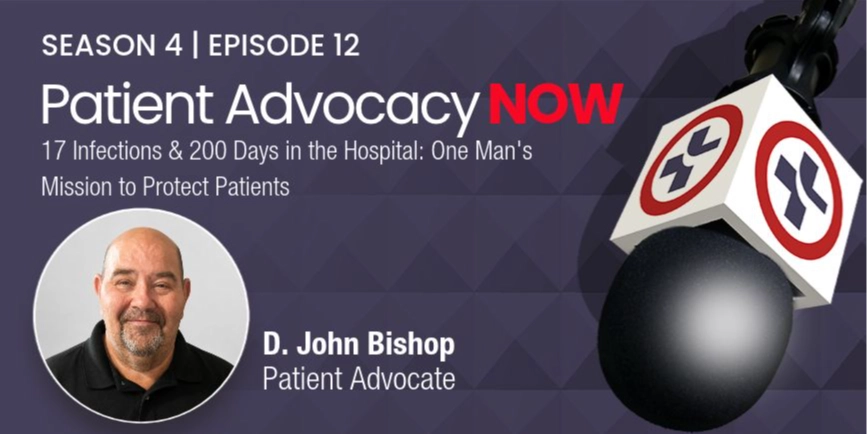
17 Infections & 200 Days in the Hospital: One Man's Mission to Protect Patients
After enduring 17 recurring spinal infections and spending more than 200 days in the hospital over four years, John Bishop turned one of the most difficult experiences of his life into a mission to help others. Now the founder of DJB Advocacy LLC, an independent patient advocacy practice in Cincinnati, Ohio, John shares his harrowing journey through repeated hospitalizations, life-threatening infections, and the emotional toll of navigating a complicated healthcare system.
In this episode, John discusses the dangers of hospital-acquired infections, particularly antibiotic-resistant MRSA, and the importance of patients and families understanding their rights, asking questions, and speaking up when something doesn't seem right. He also explains how his experiences revealed gaps in communication, care coordination, and patient support.
The conversation explores the growing role of independent patient advocates, the challenges of navigating insurance and medical decisions, and why having someone in your corner can make an enormous difference during a medical crisis. John's story is ultimately one of resilience, purpose, and transforming personal suffering into meaningful service to others.
Connect with John at www.djbadvocacy.com/
TRANSCRIPT:
Host
John Bishop is the founder of DJB Advocacy LLC. It's an independent patient advocacy practice based in Cincinnati, Ohio. His commitment to advocacy grew from his own experience with 17, that's right, 17 reoccurrences of immersive spinal infection in more than 200 days in the hospital. Having experienced the fear, the uncertainty, and the exhaustion of serious illness, John understands how difficult it can be to ask questions, to absorb information.
And make decisions from a hospital bed. So he helps patients and families navigate those challenges through bedside support, care coordination, medical record review, and communication with healthcare teams. He has a particular interest in hospital-acquired infections, which we'll dive more into in a moment with him here live, including MERSA infections, C. diff infections, surgical site infections, catheter-associated urinary tract infections, and central line associated bloodstream infections.
His focus is helping patients and families understand the information their care teams provide, communicate concerns, and navigate treatment and recovery. Brings decades of business ownership and a personal understanding of living with disability to his work. I'm really happy to have you here, John. Thank you so much for joining the podcast.
John Bishop
Thank you, John, for having me on. I'm excited to be here with you.
Host
So seventeen infections or seventeen instances of NERSA, two hundred days in the hospital. it's a hospital acquired infection. Do they know did do they know where it came from? And in some
John Bishop
You know.
John Bishop
They do, they do. I had an infection of my left leg. I was unbelievably lucky. I had four surgeries in six days to keep that leg. And for third surgery, they're prepping me for surgery, and the surgeon came in and said, Hey, we're we're not we're not doing a great job with this. and you need to be prepared. If you wake up, you might not have a left leg.
You know, and I thought, okay. and when I woke up, I very fortunately had a left leg. but they had done a lot of work to debrision, which they basically go in and chew out as much of the infection as they could see. And then where I got in trouble was I had skin grafts. They took skin grafts off my thighs. And on the third and fourth procedures, I had skin grafts done.
And three weeks later, I couldn't get off my couch. I had an infection in my spine. And through some research from the days at the hospital, three other people got sick that day as well. Mirsa was present in the operating
Host
Wow. And the and the other people got infected as well? I did I hear that right?
John Bishop (02:55.8)
And you know they did. They did. Now now the hospital wouldn't share much information with me. And you know, everybody says, you know, you should sue. And well, two things. first, I don't think you could ever sue a hospital. It's very difficult. And secondly, it's not on my personality. it it takes a lot of energy to sue something like that. And I just don't have any interest in that. I still don't have any interest. And I held hold no ill will.
Host
Yeah.
John Bishop
To the hospital because especially now because I've learned so much. staff and MERSA are present in basically every hospital in the United States. So it's just a matter of how serious it is. So people get upset about it, and I think educating the public is a huge, huge thing, and hopefully that's part of what we're doing now.
Host
Yeah. Absolutely. That's that's the whole point of talking to each other here. w talk to me about post the infection. we'll work backwards. So how did it affect your life and your family's life after the 200 days in the hospital? Like what what what was the repercussions of all that?
John Bishop
I'm gonna go back a little further if you don't mind. I owned an architectural working shop in Greater Cincinnati area. And at the end of twenty eighteen, I thought, boy, something's not right. You know, so I ended up closing my business of 35 years. So that's really hard, you know, financially and emotionally. I was the main, you know, monetary winner of the home. My wife was always involved in the business, so that's a big change. Then February fourth.
Host
Yeah, sure.
John Bishop
of twenty nineteen is when I had the illness with my leg. So they did surgery right away. And then my first hospital stay in regards to that was 28 days. So that's a long time. You know, I think eleven of those were in ICU. they just they weren't doing a great job controlling the infection, but I don't think that's a surprise.
MERSA's what they call a superbug. MERSA's a super well, it was a surprise then, but now I understand it a little more. MERS is what they call a superbug that basically was created in the hospital system over many, many years over over-prescribing IV antibiotics and antibiotics in general. So I guess a lot of people I guess began to have.
Host
W why is that why was that not a surprise?
John Bishop
immunity to a lot of the other antibiotics. So then they ratchet up the antibiotics and it get becomes very risky because then essentially if you have a very serious surgery and they've used other IV antibiotics, like they used to give me what was called daptomyosin. It's a tier one IV antibiotic. And they warn me, hey, if you had if you were in a car accident and I got an infection, I might be in trouble.
Because that's one of the IV antibiotics they keep in their pocket to to help make you better and healthier. So and that's pretty scary to be honest with you. you know, you wonder in your mind, hey, will I actually get better? So, and they, you know, originally they couldn't identify the organism. They used medication called banchomyosin, it's a broad based IV antibiotic, but
It doesn't do a great job against Marcia. So and then
Host
I think there's this concept that people have that a pill will just fix any infection. at least in in the layman's terms, right?
John Bishop
you're absolutely right. Yeah, and then MERSA, it's an acronym, MRSA, Meticillin Resistant Topacus Areas. It's a big word for antibiotic resistance staff. That's all it is. So, and obviously people don't really have to worry about MRSA being in their homes. it was more or less cooked up in the hospitals. So, and then more it's it's not a matter of cleanliness.
like, hey, the hospital's dirty. It's not like that. It's I mean, it's it's a bug, it's a germ, you know. And I I think that terrifies people because you can't see it, you know. If you see that your room's not clean in your hospital room, I could do something about that. But the idea of getting a hospital-acquired infection like I got, I think that really scares people. So, and I've been involved with that many times. You know, they go in for an elective surgery.
Over the weekend, holiday, a knee replacement, a hip. they wake up in recovery and they might not be in recovery. They're in inpatient. They've been admitted, you know, and somebody's going to be talking to them about, hey, you've got an infection. Usually they don't know what type right away, but there's a good chance that it's a staph infection. So, because that's the one, that's the most common one.
And you you gotta imagine you're in there, okay, you have a procedure, your body's weak, you're under anesthesia, and that's the time. That's when the infection kind of comes to get you. it takes advantage of a weak, you know, the person's weakened immune system. And that is really, I think, the essence of hospital-acquired information.
Host
So that was that started February twenty nineteen. Walk me through walk me through the two hundred days, how over how long a period of time and then what happened to you after?
John Bishop
Yes, sure.
John Bishop
It was over a period of four years, a good friend of mine pointed this out to me. He said, you know, the math works out to one day a week for four years I was in the hospital. So and I told him I could live the rest of my life without knowing that information. So but it's not one day, it's six days, eight days, nine it's you know, they're always in groups. And then it just seemed to be reoccurring. I had
Host
Ha ha ha ha.
John Bishop
not great luck at the beginning with infectious disease. And I ended up doing a little hospital jumping. I didn't know any better. And then I settled into one network and found a very competent infectious disease doctor that in my opinion saved my life. So multiple times. they figured out for me it was a cocktail dactomycin
Maripenum and Maripenum. And here's the thing. That's three doses is three times a day. So I'm taking nine IVs a day, you know, and each go round is about an hour and a half. So it's four and a half hours of IVs per day. And one of them, because they're eight hours apart, falls in the middle of the night. So that became troublesome.
Host
And and that was that was during that was during the four years, or is that even to this day? Or or you that's wow.
John Bishop
Yes, sir. That was during the entire four years. So and I would wake up on my couch and I'd be like, no, I fell asleep again. I'd look at the IV bag, it's empty, God knows. A lot of times blood would back up into the line. I'd take it off, you know, yeah, force it through with and flush the IV and I it doesn't hurt you, but it's not a great thing to do. or even worse.
I don't pay attention, I don't set the drip rate properly, which is a big deal. And boom, it shoots into you. And then three minutes later you're starting to feel a little lightheaded, and you're like, I did it again. So, and all of that is a matter of discharge. When you leave the hospital, it's critical. A team's gonna come in and go over all this with you. Then most likely at home nurse is gonna come to your place and you're gonna have a pick line up.
Peripherally and sent it inserted central catheter. It comes in from you know your bicep up your arm and across and drips right down into your heart. So that's something that you want to keep clean. So they'll usually do dressing changes twice a week. if you are a righty, it would be better to have it in your left arm. If you're a lefty, righty, you know, for obvious reasons.
Host
Right. Right.
John Bishop
You have to be careful with it. and just try to, you know, keep it covered up and they'll train you on how to clean it and really follow those, you know. I had one, two, I think three different PIC lines get infected and they test They pull the PIC line out, send it off to a lab, then it cultured with MERSA. You know, not in my blood, but on the PIC line, you know. So then they replace it. And
Host
Well.
John Bishop
Yeah. It became just, I don't know, it's unbelievable what you can get used to. my family got used to it. I got used to it, that just being in the hospital, I'd get sick and it's like, okay, I have to go to the hospital again, you know. and I tried making all kinds of lifetime changes and I just was not, I wasn't fortunate. now I'm s I'm not clinical. I'll do the best I can here explaining the way it was explained to me.
Host
Yeah.
John Bishop
About halfway through it, let's say seven, eight infections roughly, a very smart infectious disease doctor said, Look, you've got a problem. That infection has colonized with your body. And I said, What does that mean, Doc? He says, Well, it's in your spine. There's two problems there. It's in dead tissue. So when an IV and bloodstream only carries blood to live tissue. So
They couldn't get medicine to the dead tissue. That's the first problem. The second problem was my immune system, it had been there for years. It thought, well, that's not an infection. That's John. Okay. So it doesn't rally and fight that infection. and that's very, very common with many recurring infections that it colonizes with the body and
The body's immune system doesn't do a great job finding it off. Does that sound overly technical?
Host
Wow. No, no, that was clear to me. What happened after the four years? Or did you did you experience a full recovery? What's going on now?
John Bishop
No, I don't think you ever, quote, get a full recovery. it's still in my blood, literally. It's in my body right now as I sit here talking to you. and that's the other thing. For me, it's quote,
It's been properly treated. Is it eradicated? Do they kill it? No, they can't kill it. You know, if they could kill it, everyone would be very happy. but essentially, like I said, MERS is a super bug, they can't kill it. but the majority of people, if they don't have as many reoccurrences as I had, they're not gonna have to worry about it. You know, I still have to get blood draws every other month. and they'll watch my labs, you know, see reactive protein.
My wife, blood cell count, sedimentation rate. And that can be troublesome. If I get a bad blood draw and it's not great, they send me to hospital. That's where the trouble starts. We have a great system, but the emergency room clinicians in particular, they're not equipped to deal with someone like me. So, and nine times out of ten, they stick me in the hospital. So
until one of my participating IV ID doctors, infectious disease doctors, can kind of jump into the process, I'll be stuck there. So and that's that's common for I think for people with many advanced, you know, comorbidities, so to speak. they a lot of emergency rooms are meant to treat trauma and are
Definitely not meant to treat someone like
Host
Being that you were in the hospital in and out so often over four years, you probably became a veteran of the space. When did you realize that having somebody by your side asking questions or doing things to help you would have been a resource that you would have appreciated?
John Bishop
I would say the third or fourth go round because you start to see patterns in the hospitals. And then this is very important to point out. I was in three different systems and hospitals have a personality. Would you agree with that, John?
Host
Yeah, for sure. Each each one is has its own little rhythm, its own kind of you know, collection of of personalities that kind of dictate the tone of the hospital. Yeah, I would agree.
John Bishop
Yeah, and
John Bishop
there's no doubt. There's no doubt. Yep.
Yeah. And then it took me a while to figure that out, figure out what the personalities were. And then where I think an advocate really could shine is if they're familiar with the systems, they know those little nuances, like you're saying, and they're going to be familiar within the system and probably have a lot better luck than any individual would be. And the number one thing I always tell people, there's nothing to be afraid of when you're in the hospital. They're going to be scared.
You know, if you're in patient, I don't care what it's for, there's a very good chance you're you you're gonna be scared. So, and that's really we're an advocate. We're not clinical people, but you could say, Hey, this is what you're going through, this, this, and this. In my case, I'm blessed. I could share my knowledges, my experiences with them, and that that makes them feel better, you know. if you could calm them down enough, then then they can make
proper decisions for themselves. I think that's what advocacy is all about.
Host
Why do you why do you say that it was the third or fourth go around where you started realizing it would have been beneficial? The first two didn't really didn't you didn't feel it, but the by the third time something stood out?
John Bishop
I think the first two were just a blur. I mean, I'm just terrified. I'm so happy to get out of the hospital and go home alive. I'm not focusing on anything except not being in the hospital, you know. Then maybe the second time was the same. Then I'm gonna say third and fourth. I started looking around thinking, I could have, you know, probably had some help. I didn't know what an independent patient advocate was. You know, a lot of hospitals, I know this now.
have in hospital advocates, you know. Now people are gonna argue all day about which is better. I don't think, in my opinion, independent is better because well the hospital advocate, the guy signing his paycheck, is the one that you might be costing money. Do you understand what mean? If they're talking about a procedure and all of a sudden it costs the hospital 30 grand, you know.
I think that's a conflict of interest for the hospital advocate to be right in the middle there. That's a tough place to be, you know, versus an independent patient advocate. Our loyalties are to the to the patient, the client. and I think that gives us a lot.
Host
Yeah. Yeah.
Host
Right. 'Cause you don't have it's you can't serve more than one master is the idea. So you have you have like an unf an unfiltered line.
John Bishop
No sir. No. And I think it's a lot clearer boundary. It's look, I work for this guy, this girl, woman. and it's it's just easier, you know. And then I had a lot of volunteer time at a local hospital and we spoke about a little on our intake, and I I got to see a lot of things that I didn't like, you know. I got to see behind the curtain, so to speak, and that that
That's a little scary sometimes. and to a normal person that wouldn't have had my stays in the hospital, if they experience something like that, then they're really, really gonna be upset. And it could really turn them off of
Host
When you say experience something like that, what are you referring to? What are the things you're referring to that are things you saw you didn't?
John Bishop
let's just pick an easy one, medication, giving someone the wrong medication. that happens every day. So, and once you've witnessed that, I've witnessed it many times, and it's like, ooh, that's scary, you know. and the if you're the patient and you've never seen anything like that before, then all of a sudden you're witnessing that, and God forbid it's you, now you're terrified. Okay.
You're starting to question the entire system, you know. my God, am I in the right hospital? Am I doing the right thing? Versus let's say I'm at your side. I'm gonna slow you down. let's let's take a breath here. Okay. This happens. All right. The best thing to do is did you go over the medication list when you came in to avoid doubles, duplicates, missed doses, allergies, you know, all of that is really important, you know, including supplements.
know because most of the hospitals have great algorithms that will pick up medication interactions so which is a a really big deal too so but i think it just scares people you know the idea that somebody you just got your neighbor's medication is is is it's very it's terrifying so
Host
Talk to me about your journey from patient to advocate. What was it like? You mentioned you did some volunteer time. How long? When did you decide to become an independent advocate? And, you know, I w at the top of the podcast we talked about obviously some hospital prone infections as as being things you specialized in. Kind of what work you do now? Walk me through it all.
John Bishop
Okay, I guess at 2024, I was volunteering at a local hospital for about nine months and ended up transitioning out of that, and that's really when I started to push hard into advocacy. So big time. I thought, you know, look, I've got some skills that I've learned through my life lessons, through the knowledge I acquired.
when I was inpatient, and then also nine months of being a you know, a volunteer at the hospital. And one of the things I did was I was in charge of a inner city hospital waiting room, which is it could be a bit of a zoo, you know. and then I also interacted a lot with the patients. My training for that role came at a level one trauma trauma center, which was the University of Cincinnati Medical Center.
Host
Yeah.
John Bishop
I was there for about two weeks in that role and that was fabulous. I mean, really, I'd never been exposed to, you know, a level one trauma center and the emergency room. It's it's really it's fascinating to be honest with you. To watch the machine work when it works properly is it's it's a joy, you know. it it really is a joy. So, but I guess I formed my business an LLC, got some, you know.
Literature, business cards, a website, and a lot of that's just happened in the past three months. You know, so moving forward with that, I'm really excited about it. I've had five professional cases so far. certainly I can't share any personal stuff, but it's you know, if if I
Host
Right. And what do you what do you find what do you find people need help with the most in your short time, you know, in as a independent advocate?
John Bishop
Navigating the system and insurance without a doubt. Those two creatures. you know, the system is very confusing. one I just recently still working with yesterday, just trying to get referrals within her HMO, it's it's really hard, you know. And then coordinating with her PCP, etc. And this is important too because she's a timid creature. So
And I think one of the reasons she came to me is I don't have a great filter and I I'm always gonna be on the side of my client, the patient. And I think that made her feel better. So and I think I don't think you can stress that enough, you know, and some people say
Host
Well speaking of speaking of being on the side of your client and not having a filter, do you feel like it can ever go too far when you're advocating for, you know, a a patient? Tell me about that.
John Bishop
You can't.
without a doubt you can. and that's where having some professional boundaries is really important. if you become too emotionally involved, then all of a sudden the client patient doesn't make great decisions because they're sick and he and really overly emotional. Well, you just had the potential to draw yourself into that exact world. and and I really keep a pretty close eye on that to to try to avoid it, to be honest with you.
Then in the advocacy community, a lot of people say a huge weakness is being too emotional or being too caring about your patient, or it's not my patient, it's the hospital's patient, it's my client. I mean, I agree with that, but I also think that being connected emotionally with your clients really important because you establish trust.
Host
Yeah. What do you
John Bishop
And well, you're establishing trust with someone who's really scared, you know, they don't like the system and they're not sure if they're going in the right direction. So if you can establish some trust and rapport there, boy, that really helps them out a lot, you know, not only physically but emotionally.
Host
Yeah. Talk to me a little bit more about infectious yeah hospital acquired infections and what you wish patients, families, or even other advocates understood about it, because it's not a specialty everybody has dabbled in.
John Bishop
Yeah, I mean, probably the most important thing is how common they are. I'm using very rough numbers here. The most recent stuff from the CDC is roughly one in thirty-six. People that go into the hospital for an elective procedure are gonna leave the hospital with a hospital-acquired infection. So now when you apply that across the board, that that's a lot of people. So it would be a matter of if the public was a little more generally educated.
about those risks, you know, and just what they're doing from simple things to hand washing. If you know, a nurse or a doctor comes into the room, don't be shy about that. You know, if they're gonna tend to your wound, your IV, maybe your post surgery and they're gonna take care of a dressing change and you notice they didn't wash their hand, I don't think it's unreasonable.
Just to say, I'm sorry, doctor, would you mind washing your hands? And I I've done that myself. I I think it's how you approach it. So long as you're not disrespectful or rude, they don't mind at all. You know, because I see it the other way. When I volunteered, these are very, very busy overworked people. Okay. He probably or she just came out of a room and they just literally forgot. You know, it's not their intent to try to hurt you or harm you. they're just busy, you know.
Host
Yeah, I think that's great advice.
John Bishop
if the other thing is, I don't want to seem paranoid here. I do tell people this if you don't have a reason to be at the hospital, don't be in the hospital. So especially if you're visiting a loved one or if you're elderly or if you have are sick or have a weakened immune system, you don't belong there. You know, you you literally don't belong there. A newborn would be a perfect example.
Host
Yeah.
John Bishop
Don't go to the hospital to visit a newborn, especially if you're older or you have an illness. Wait for them to get home. You know, give them a week to let them get settled in. I mean, because the chance of you sharing your germ or bug with that newborn whose you know immune system isn't even started yet, is it's really high.
Host
I think that's sound advice, especially post COVID. We all saw firsthand how, you know, really germ aware or germ conscious we have to be.
John Bishop
Yeah. What's interesting, I I was inpatient at the hospital during COVID, you know, so I got to kind of live through that. Witness it, you know, you can't go out of your room without a mask on, even if you're I'm going to surgery, literally, you have to a mask on. You know, the only time you're allowed to take your mask off is if you were in the room. If a clinician came into the room, you had to put your mask on. So I took a lot of those knowledge and information and I kind of carry it forward with me.
Host
That's great. John, thank you so much for sharing your story. The name of your advocacy practice is DJB Advocacy L L C. What's your website? Share with us with us so people can find you.
John Bishop
Yes, sir.
i it's the same. DJB advocacy dot com.
Host
Got it. John Bishop, thanks again.
John Bishop
Thank you, my friend.