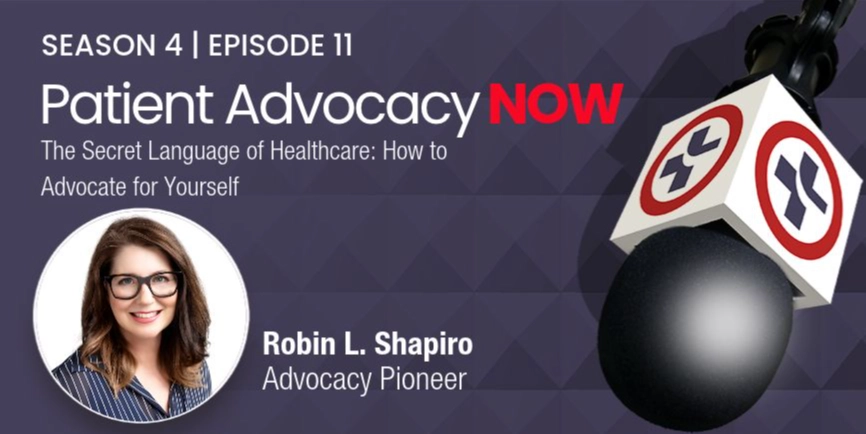
The Secret Language of Healthcare: How to Advocate for Yourself
Robin L. Shapiro, a pioneer in the patient advocacy movement and author of The Secret Language of Healthcare, joins the show to discuss how patients and families can take greater control of their healthcare experiences. Drawing on more than 30 years in healthcare communications and advocacy, Robin explains why asking the right questions, understanding how hospitals operate, and knowing when to seek professional support can dramatically improve the care people receive. She shares compelling stories that reveal how seemingly small details, such as oral hygiene during hospitalization, can have enormous consequences.
The conversation also explores the power of storytelling to educate and inspire patients, the evolution of professional health advocacy, and the importance of preparing to navigate healthcare before a crisis occurs. Robin discusses her Well Said Health podcast, her passion for making healthcare information accessible, and the often-overlooked resources available to patients and caregivers, including hospice services and end-of-life doulas. Throughout the discussion, she emphasizes that everyone deserves to feel informed, empowered, and supported when making healthcare decisions.
TRANSCRIPT:
Host
Robin El Shapiro is a health communications entrepreneur with more than 30 years experience. She co-founded Health Advocate X and is a nationally recognized pioneer in the health advocacy movement. Her book, The Secret Language of Healthcare, How to Ask for the Care You Deserve, was published based on her experiences working in health advocacy. She founded and co-founded award-winning companies that engage patients in sharing their personal medical stories, including.
Health Advocacy Strategies and Health Perspectives Group, now called Reverba. She co-founded Allied Health Advocates in 2008, the first independent health advocacy company in Washington State, and now has the Well Said Health Podcast. I'm really excited to be speaking with her. Hi, Robin. How are you?
Robin L. Shapiro
Great. Nice to be here.
Host
Glad to have you. So you let's get started with how you kind of even came into the health space, how the health advocacy industry, because you know, some people come in because they're retired or frustrated nurses and doctors. That's not you. I'm always curious how someone like you with with your background even got into the space.
Robin L. Shapiro
Ha ha.
Robin L. Shapiro
Yeah, so my background actually is in healthcare communications. And I worked for Ogil via Mather really long time ago and then got recruited out for a biotech company in Seattle. And there I really had the opportunity and the honor to work with a lot of patients and hear their personal medical stories, and I was really moved by them. And it it that's what led me to.
Start my first company, Health Advocacy Strategies, in 2002. And that company focused, focuses on helping people share their stories to inspire others around medical decision making for their own lives. So I've kind of been doing things adjacent to what is now known as health advocacy, but in 2007.
I, even though I had this company that I just mentioned, I felt like I was supposed to be doing something that was more aligned directly with patients. And so a short time after that, I met my co-founder Beth Droppert, who is a nurse, longtime nurse and an entrepreneur in her own right. And she we sat next to each other in our arthritis foundation breakfast.
And she told me what she was interested in doing. And she said, when I go to the doctor with my family and friends, they get better and dramatically different care. And I think everybody should have access to somebody like me. And that was really at the very, very early beginning of what is now known as the health advocacy or patient advocacy fields. That was in like two thousand and seven. And
When we had that conversation, I said, you know, I've been looking for something like what you're describing to do next. And let's talk. And so that's how Allied Health Advocates got founded in 2007, 2008, really. And what we found was that no one knew what health advocacy was. And this was long before Greater National Advocates and some of the other organizations and many
Robin L. Shapiro
Of the thousands of people who now do health advocacy. And so Beth and I got together with some other people, including Io Dolca, who now owns Grayzone Health in Seattle. And we said, we should put together a not for profit that educates people about what health advocacy is, why it's valuable, why you might want to hire a professional sometimes, or even as a patient, why you would.
want those skills. And that organization is now called Health Advocate X, which I think you mentioned at the top of the hour. and so anyway, that's kind of how I got into it. And you know, it was it was really Beth's experience as a nurse and her desire to found that company that that got me involved and engaged.
Host
Mm-hmm.
Host
Yeah. And I think that story is something that a lot of people can resonate with, whether they have someone in their family in the healthcare space or not, the idea of having a nurse or a physician or someone who's really familiar with the hospital system sitting right next to you during a checkup or a visit with a with a doctor, the assumption that it's gonna make all the difference in the world is pretty i i everybody could recognize it instantaneously.
Robin L. Shapiro
It does. And so what what's been kind of interesting is so I'm not a doctor and I'm not a nurse, I'm not a medical professional, but I've had the opportunity to sit beside Beth and other professional health advocates and also just listen listen very critically to what makes a big difference. and where where I really love to kind of play in is
the words and the language and what is accessible to everyone, just the most basic things that most people don't know about in healthcare. Simple things really, that can make a really big difference. And so that's what my work has really focused on in the last 10 or so years. that's why I wrote the book, Secret Language of Healthcare, How to Ask for the Care You Deserve. And in it, the how how that how that came about was that
I was having the same conversations about similar topics with lots of different people. And and I'd always wanted to write a book. And so that's kind of how that came about. And so that book is really broken into 20 chapters, 20 common topics that would be relevant to any person. And it's anchored with a real and compelling story. And it has it's
Set up similarly to my podcast, and it goes into the reason why you should be interested in it, like topics like your oral health in the hospital is actually how it opens. That's the first chapter because most people don't know that when you go to the hospital, you're not necessarily going to get your teeth brushed. And that can be a problem. And most people
spend their whole lives brushing their teeth twice a day. I have a grandson and you know, that's twice a day. He's brushing his teeth and he's he's not even two years old. So anyway, each chapter as well as the episode, each episode of Well Said Health gives people the language and the questions to ask that anybody could ask that could really make a difference in navigating care.
Host
Can you just 'cause you teased it so well, can you talk a little bit more about the oral health in the hospital? What do you what do you mean by that? So like if you're at a hospital stay, your teeth aren't gonna be brushed, is that what you're referring to?
Robin L. Shapiro
Not necessarily. You you have to ask for your teeth to be brushed at most hospitals. It's not part of the everyday things. You know, nurses are really, really busy, as we all can appreciate. And so the story opens up actually. I mean the the book op opens up with a chapter and a story.
About a man who called Beth and I when we had our business, and his wife had been in the hospital for a year. And right before she went into the hospital, I can't remember what the situation was, she had had all of her teeth completely, you know, capped and redone, and they were in pristine condition when she went into the hospital. And after a year of being in the hospital, they wanted to pull all of her teeth, and that got her husband to wonder.
what had happened. And what had happened was that, and and granted, I mean most people are not in the hospital for anywhere near that length of time, but basically in that length of time, her teeth had not been brushed. So and I think you know most of us that's a very dramatic story, obviously, but one that you might not forget.
And so one of the things about that first chapter was when I was visiting a friend's husband in the hospital years later, I had remembered that. And he had been in the hospital. He actually had prostate cancer. And he was at the end stage of that in the hospital. And he was preparing for a big meeting with his lawyer to kind of finalize paperwork and that kind of thing. And he's a very dignified man and
as we were as I was sitting bedside, my my friend was like, Could you spend a few hours with my husband, you know, just and he was getting ready for this meeting. And I asked him if he he had had his teeth brushed and he said no. And I mean he could barely talk, but he, you know, shook his head no. And I said, Would you like that? And so sometimes sometimes it's just a matter of knowing questions to ask that we wouldn't have previously thought about before.
Robin L. Shapiro
So my work has really, you know, of late been focused on trying to give ordinary people who might not have the questions in their mind some of those very dramatic stories. So if they are faced with situations for them or their loved ones, they know some questions to ask or where to go to find the questions and the language to navigate care better.
Host
Yeah. So important to ask the right questions and to even know what questions to ask in the first place. Your company how long did you guys run Allied Health Advocates for?
Robin L. Shapiro
It ran until 2015. So it was really early. It was on the front edge of the whole health advocacy, patient advocacy market. And we were very, you know, Beth has been incredibly involved in getting the certification, the BCPA involved. We've been involved with greater national advocates, you know, since the beginning. It was a very small
field when we all started out and so all the organizations came together, we did conferences together and and that kind of thing. And we really all need to be working together to make sure that there are both professionals out there who are available to be hired and assist patients, but also that we educate patients and their families about what's possible in navigating care and
It's super important also to make the whole the whole language of patient advocacy and health advocacy part of our everyday lexicon. So it's not just when you are sick and navigating care that you're thinking about this, because that's a really rotten time to try to figure out that system, as we all know. yeah.
Host
What have you found to be the best ways, because you have so many years of experience in this, to get people to pay attention when they're not sick? I'm always learning for tips and tricks here, selfishly for myself, to kind of educate friends and family. Cause you're right. When someone's healthy, we try not to think about it a lot of us and just kind of move on with our day. Do you, you're a big storyteller from the way the the way you tell your podcast and your book, do you find that that engages people more?
Robin L. Shapiro
Mm-hmm, mm-hmm.
Robin L. Shapiro
I think dramatic stories are the ones that stick in people's minds. And there's a reason for that. We as human beings, since the beginning of time, you know, before we had words and ling, you know, words written down on a page, we had our voices. And so we know that stories since the beginning of time are really what lead us to you know, do things in our life. So you're right, dramatic stories, important stories. I also feel like
Stories are the way to honor people who have gone before us and have navigated care. In fact, one of the ways, and I and I often tell this story, there's a woman when I worked at at this biotech company in Seattle, and there was this young young woman who was part of our clinical trial and the product that
my company made was life-changing. And it was life-changing. She had rheumatoid arthritis. And after she had her baby, it just came back with a vengeance. And rheumatoid arthritis, for people who don't know, is it affects your joints. It's very painful. some people can't walk or grab things. For her, she was not able to use her hands. So when she had a baby, she had to diaper her baby with her teeth. And I think
For any parent or human out there to imagine diapering a child with your teeth, you can imagine how challenging and devastating that might be. And and this particular product changed all that for her. it was was very dramatic. And the reason why I tell that story is that she shared with me what her mental state was and how how dire she felt.
Before having this particular product, which really changed her life. And she said, if I can help one person not be in the mental state that I was, I will share my story. And that her story really has been like this little seed that has grown in my life and really changed the direction of my life because I just I felt like that that was one of the most powerful stories I've ever heard.
Robin L. Shapiro
Very inspiring.
Host
You it was a biotech company, so w was it pharmaceutical or was it something else, the product that helped with that?
Robin L. Shapiro
Yeah.
Yeah, it's a biopharmaceutical product for rheumatoid arthritis. Yeah, still on the market and it's still changing lives as we speak.
Host
I'm a big fan of medication. I got when it when it hits Well, it hits well. I have gout and you know, the difference between walking with a cane and not is one little pill I take and and it's it's insane how much it can change your life. So it can change it d dramatically and quickly, you know, and when it's when it's the right fit for sure.
Robin L. Shapiro
Yeah.
Robin L. Shapiro
Dramatic.
Robin L. Shapiro
It can change your life. It can change your life.
Yeah.
And it's so amazing that people are willing to share that transformation and give other people hope because I don't know what your particular story was, but when you're hurting for a long time and you can't walk, for instance, it's it's really tough. It's really hard.
Host
Yeah. Yeah.
Host
I you know, I think it's it's interesting that you say people are willing to share. I I have I've had the opposite experience where if someone's been suffering, like I couldn't play with my kids and I had a hard time walking to my office on time and I was I didn't have it long enough to get handicapped parking because it was always on and off. So I still had to walk from the car. I mean, it was just all and it was in flare-ups and you know, I was like, if I can help even one person not go through the struggle that I went through a
Robin L. Shapiro
Mm.
Robin L. Shapiro
Mm.
Host
I'm gonna shout it from the rooftops, like try this, try this, try that, you know. but but you're right. I think that listen, it's it's different to walk with a cane versus diapering your child with your teeth. There could be some embarrassment or shame, you know, for certain people. So it depends on what they're going through. You're I mean, I never thought of it that way. That could be a big part of the puzzle that I was missing there.
Robin L. Shapiro
Right, right.
Robin L. Shapiro
Well, first of all, I'm sorry that you suffered with that. And I'm thrilled to hear that you there was a solution. So that's that's really amazing. so that's the it's a dramatic difference in your life. And when you think about all the people out there who are suffering who might not yet have a solution or might feel like they want to give up, the point of health efficacy is trying to figure out a way to see through.
Host
Yeah, me too. Thank you, yeah.
Robin L. Shapiro
to the other side of when whatever it is is happening to you at the moment is not forever in, you know, whether you're gonna have a disease ongoing or disease process ongoing. There are many different ways to travel through hardship and health hardship and and health advocacy definitely lights that way. I and I also just wanted to say that what I think is so
Astonishing and gratifying is, you know, however many years hence it's been almost, well, it'll be 15 or so years since Health Advocate X was founded and a lot of other organizations like Greater National Advocates. Just the fact that there are so many professional health advocates out there, many with specific niches to help individual patients and their families, it's just it's really gratifying to see the growth of the field.
Host
Absolutely. Is that what keeps you engaged in the space yourself is seeing the growth and seeing the need? Does it I mean, let me I'll rephrase the question. Does it bring you joy to do this, or is it still kind of a bit of a heavy heart when you go over these stories?
Robin L. Shapiro
No, it is not a heavy heart. I mean, I I hate to hear people suffer, but it is you know, there's there are a lot of things to do in the world. And I in my life and in this work, it is more and more gratifying every single day to hear people's stories, pay honor to those stories, but also see if there's some way to help.
Because there's a lot of help out there that most people don't know. I had a friend of a friend recently who is at end end stage cancer and hadn't talked to her in a very, very long time. And she had gotten in touch because she knows what I do. And she said, I have gone through treatment and the tre I'm there's there's no more treatment for me, basically. And I don't know how to do the next step.
But I probably need to be talking to somebody in hospice and I don't even know all the things in this next step. And you would think that that was, I mean, it was terrible, obviously, to hear. I was so sad and devastated to hear that. And also I felt really happy that I could connect her with hospice resources, the
last chapter of my book and an upcoming podcast segment is with a death doula, which most people have not heard of. And yeah, super interesting. it's there are many more death doula's out there than there were seven years ago, but it's still kind of early days. But just just like a birth doula, death doula is somebody who helps you in a non-
Host
First time I'm hearing of it, yeah, for sure.
Robin L. Shapiro
medical way at the end of your life. And so it's a super interesting, amazing role. And so it's been I I feel so lucky that I get to enter, you know, do a podcast and talk to people who have real hope and options for people who are struggling to navigate healthcare and
I just I love learning of all the new ways. And yes, people's stories are hard, but like I just talked to somebody yesterday and her father-in-law is at the end of his life and and we were talking about a lot of different things. And when she was talking about that kind of as a throw a away line, she said not not to be a downer or not to bring things down, and I said her name and I said
Stop right there. I said part of life is death and end of life and hard things. And don't you don't ever have to apologize for talking about things that are hard in life. It's an honor to be able to talk about those things and not shhy away from them. So yeah, that's kind of how I feel about it.
Host
Well, it sounds like you're aligned with the cause. I mean, if you're going to summarize the the mission and the reason behind your podcast, because it seems like it goes in different directions, what's what is your goal? Is it is it to educate, is it to inspire people? And is it directed solely at the patients, or do you feel like even medical professionals kind of get something out of it?
Robin L. Shapiro
that's a good question. Nobody's asked me that. so it's really focused at the person who helps everybody navigate care. So the person who's actually engaged and does probably her research, because we know that women do the majority of, you know, navigating.
so it could be for patients themselves or for the women who have responsibility for their parents or their children. And the mission of the podcast is really to educate, inspire, and give the specific language to people to help them navigate care better through storytelling and through introducing people to either experts or people who have been there. So not not eat.
Each of the episodes might not have an expert, like a medical expert. It might be somebody who's lived through an experience in a specific way.
Host
What's been the most surprising thing about doing the podcast for you?
Robin L. Shapiro
What's been the most surprising thing? it takes a lot of time to do it. It takes it takes a lot of time. It's been yes, as you might know. And I I knew it would be a bit of work. and I'm I'm I'm happy to do the work. It's been it's been a learning experience. So that's been super fun and
Host
That's for sure. I could back you up there. Yeah.
Robin L. Shapiro
maybe surprisingly I didn't know all the different aspects that would need to be attended to in order to put it on. But but
Host
Yeah. I think, you know, it's it's it's interesting. You have the healthcare background. And so but maybe not as much as the tech, and I'm the the reverse. But the the thing that surprised me that you're probably like, well, I already knew that because I'm 30 years in. I didn't realize that you that you would never run out of stories to tell. That there's just there's an infinite bevy of stor you know, just it's never going to end. There's always someone with a new diagnosis or a new story or what happened at the hospital.
Robin L. Shapiro
Yeah.
Robin L. Shapiro
Mm.
Robin L. Shapiro
yeah.
Host
And as many as you hear, you're still shocked by that.
Robin L. Shapiro
Yeah, it it is I mean people's lives are endlessly fascinating any anyway. and I think one of the things that I'm looking for so I'm I'm pretty new at this, right? I I'm in early days. The podcast has only been out since September of twenty twenty six, depending on when your listeners are listening, but it's we're now in October of twenty twenty six.
Host
Mm-hmm.
Robin L. Shapiro
So I only have four episodes out so far. So one of the things that I'm trying to do is get feedback from people about what they want to hear and what resonates with them. my second episode is about meeting the hospitalist, hospitalist, which many people don't know what that role is. and that's Clark Kohler is my guest for that. He's a hospitalist in
the Seattle area and a hospitalist is somebody is the doctor who's in charge of your care when you are in the hospital. And many people don't know that. And not knowing that is a problem because then you don't know like how decisions are made and like when you would get discharged or who's the person in charge. And so
I it I I met him actually and didn't know that he was a hospitalist. I got to know him and then kind of like four or five times after, you know, having dinner or whatever, I was like, Do you work? Or, you know, because he's very fun and quirky and he's he's an amazing guy. And he's like, Yeah, I'm a hospitalist. And I have to, you know, true confession, because of the work that I have overheard.
patient and health advocates do, a lot of them are not particularly fond of hospitalists because hospitalists have a really heavy load and it's sometimes, you know, hard to work with them. So when he told me that that was his role, I was I was super curious, like, why would a guy who is like he's super duper smart, he's detail oriented, he's, you know, he was, he's quite something.
And so I was really curious about him and what drove him and what his perspective was of this role. And so, so it's super fun to uncover, you know, information, people's stories and also then think about, you know, what are the top things that people need to do when they are in the hospital and talking to their hospitalist that could really make a difference. You know, there's there's a lot. So
Host
Well, I appreciate you looping in that human element. To me, the stories are always what I remember and why I love being part of this podcast as well. I just to remind everybody, your your podcast is called the Well Said Health Podcast. And the book that you wrote, The Secret Language of Healthcare, How to Ask for the Care You Deserve, is that available everywhere for people to pick up at this point?
Robin L. Shapiro
Mm-hmm.
Robin L. Shapiro
Yeah, through Amazon and yeah. And I also have a website called wellsaidhealth.com. So and yeah, yeah. And you know, you'd asked me before kind of who the podcast was for. I would also say that the podcast is for health advocates because we look at different topics through the lens of health advocacy. How are we engaging and empowering people?
Host
Well said my taco.
Robin L. Shapiro
to ask the questions and navigate healthcare better. And that is an essential tool of every patient or health advocate's toolbox.
Host
I couldn't agree more. Robin Shapiro, thank you so much for visiting us. And maybe we'll have you again as your podcast gets more episodes under its belt. You can share some more stories with us.
Robin L. Shapiro
Thank you so much. I appreciate being here today and I enjoyed talking to you.