

No Help, No Clarity: The Wild DME Chase Before Discharge

What You’ll Learn in This Post
By the end of this blog, you’ll know:
✅ Why you can’t always rely on discharge planners—and how to spot when you need to step in yourself.
✅ What to ask before discharge to avoid delays and missing equipment.
✅ How to confirm in-network DME suppliers (and why the “official list” might not be accurate).
✅ What critical mistake I made that came back to haunt me months later.
✅ Why documenting every call matters—and what information to collect every single time.

When my husband entered the discharge-planning stage at a subacute rehab facility, I was told to start preparing for his transition home.
Why Didn’t the Discharge Team Handle This?
You might wonder: “Why didn’t the discharge planning staff handle this for you?”
The short answer? I couldn’t risk trusting them to get it right.
Here’s why:
- No guarantee of timely delivery.
I asked more than once if they could ensure all the equipment recommended by PT and OT would be delivered before my husband came home. No one could give me a straight answer. He was bed- and chair-bound at the time—where exactly was he supposed to sit or sleep if the equipment didn’t arrive on time? - Not everyone is qualified just because they have a job title.
I wish this weren’t true, but I ended up teaching the discharge planning staff basic things they should have already known, including:
- The difference between inpatient and outpatient treatment plans
- The difference between the length and width of a hospital bed (a critical distinction when you’re trying to fit it into a bedroom)
- That a wheelchair with rims wider than a doorway won’t fit through it
- That I needed written prescriptions before taking my husband home, because I work full time and couldn’t risk being stuck later if something went wrong
These weren’t minor details. Every mistake, every delay would fall on me—not them. So while I wish I could have relied on the discharge planning staff to handle everything, I couldn’t. I had to do it myself.
His physical and occupational therapists were clear— we needed this equipment to keep us both safe:
- Hospital bed
- Wheelchair
- Shower chair
- Slide board
- Hoyer lift
So I did what you’re “supposed” to do—I called the insurance company to confirm what would be covered. Thirty minutes on hold, and the rep finally picked up… only to tell me they couldn’t give me that information. Instead, I had to call a third-party company that “handles DME networks in your area.”
I pushed back. “Shouldn’t the answer to what equipment is covered be the same before and after I call them?” The rep wouldn’t budge. The “process” was more important than the patient, and the process had to be followed.
With only two days left before discharge, the runaround officially began.

The List That Didn’t Help
Another 30 minutes on hold, and I finally got to speak with a rep at the third party company. The third-party rep rattled off names so fast I couldn’t keep up writing them down.
As a former social work discharge planner, I know the major players in this industry. But as she sped through the list, not one name sounded familiar. For context, we live in a rural North Carolina county—but we’re not far from the state capital. Finding a DME supplier shouldn’t have been this hard.
I finally interrupted and asked her to slow down. Since my husband’s surgical complications, I’ve developed anxiety (so many caregivers have it), and it slows my auditory processing. (Translation: I just needed her to talk slower so my brain could keep up.)
Asking for clarification is normal. The dramatic sigh she gave me? Not okay. That’s when it hit me—something about the list she was rattling off didn’t add up.
Taking a Calculated Risk
Something felt so off that I tried another tactic. I called a trusted local provider and asked directly, “Are you in-network with our commercial insurance?”
After verifying my insurance details, they confirmed they were—even though they weren’t on the official list.
Here’s why this was risky: the accuracy of insurance in-network information is only as good as the person you’re talking to. If this DME rep was wrong, I could have ended up with a massive, out-of-network bill. But the risk-to-benefit ratio mattered because we were only two days from discharge. Delaying his homecoming wasn’t an option, and every detail to make it happen was on my shoulders.
So I chose the local provider. They guaranteed the equipment on time, and honestly, that “official list” didn’t seem reliable.
My husband needed care, not paperwork delays.
Back to the Beginning: What’s Covered?
For my fourth call that day, I went back to the insurance company and asked what specific items were covered. I was overwhelmed, exhausted, and juggling ten mental tabs. I took notes in the margins of a journal—but critical mistake—I forgot to get the rep’s name and the call reference number. Here’s the thing, when your anxiety is up, your hours of sleep are down, and the stakes are high, it’s easy to let an important detail drop.
That detail would come back to haunt me.
The Equipment Arrived. So Did the Bills.
The equipment arrived on a Tuesday morning, with the delivery staff working diligently to set up everything. My husband came home two days later. I exhaled.
It felt like we’d made it across a finish line.
But a few months later, the bills started showing up in the mailbox. And that’s when I realized:
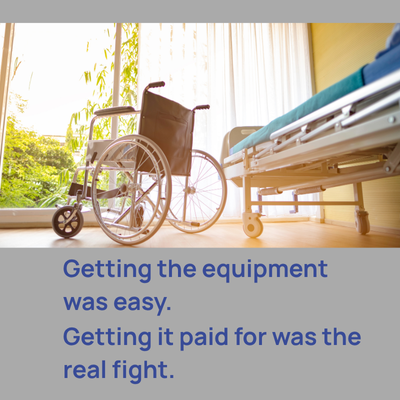
Getting the equipment was the easy part.
Getting it paid for would be the real fight.
Truths from the Frontlines
- Even healthcare advocates need an advocate. I was too busy to catch every detail. I was busy being a wife, a pretend PT and OT, bedside nurse, and care aide, not to mention a full-time employee.
- No one has to accept rude treatment from customer service reps at an insurance company.
What Comes Next
Bringing my husband home felt like crossing a finish line, but in reality, it was only the end of the first lap.
Because getting the equipment delivered was the easy part. Getting it paid for was going to be the real fight—one I couldn’t afford to lose.
For every caregiver out there: if you feel overwhelmed by the phone calls, the rules, and the constant second-guessing—you’re not failing. The system is designed to make this harder than it needs to be.
And that’s why caregivers need help sometimes. Even the best advocates can’t do it all alone.
Bio: Kim Feth, BSW, is the owner of Healthcare Survival Kit. We hand families the roadmap the healthcare system never wanted you to have. We guide you step by step, help you avoid costly mistakes, and give you the support you need to make confident decisions—so you can worry less and focus on what matters most: your health and peace of mind. To learn more, visit the website at healthcaresurvivalkit.com or email Kim at kim@healthcaresurvivalkit.com.