
The AI Enhanced Advocate
The AI-Enhanced Advocate
You already know the hardest truth about patient advocacy. There are never enough hours in the day. Time is your most scarce resource. As a patient advocate, you need to spend it on people, not paperwork. Artificial Intelligence (AI) isn't here to replace your empathy; it is here to act as your unpaid intern, handling the drudgery so you can focus on the strategy. In my work training advocates to use technology through Sonoran Wayfinders, I teach how to get started safely using free tools available right now.

The Golden Rule: Privacy First
Never put patient data into a public AI tool. Treat tools like ChatGPT like a public bulletin board. Use them for general medical concepts, templates, and research. Never enter names, dates of birth, or specific medical record numbers.

The Toolbox: What to Use
You don't need expensive software. These three free tools cover 90% of your needs:
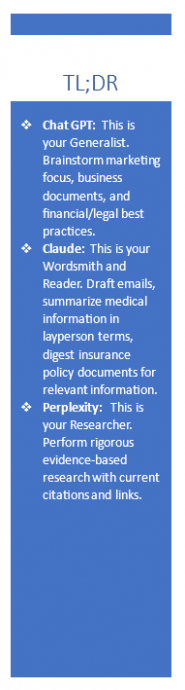
- ChatGPT (OpenAI): Your Generalist. Best for brainstorming marketing focus, business documents, and financial/legal best practices.
- Claude (Anthropic): Your Wordsmith and Reader. Best for reading long documents, drafting emails, summarizing medical information in layperson terms, and digesting insurance policies.
- Perplexity: Your Researcher. Best for performing rigorous evidence-based research with current citations and links.

The Strategy: Context is King
To get the best results, you must «prime» the AI. This is a core pillar of the AI curriculum I teach to Board Certified Patient Advocates. Don't just ask a question; tell the AI who it is (a specific persona) and exactly what you need. Below are four «Copy-Paste» prompts you can use today.
Use Case 1: The Jargon Slayer
The Goal: Quickly translate complex pathology reports or clinical notes so you can explain them to a client without spending hours on Google.
Use Case 2: The Fact-Checker (Must use Perplexity)
The Goal: Verify treatment guidelines or find studies to support an insurance appeal. As a former medical device clinical project manager, I know that data accuracy is non-negotiable. Standard AI «hallucinates» facts. You must use an AI connected to the web for this to ensure accuracy.
Use Case 3: The «Professional Pushback» Email
The Goal: You need to write a firm email to a dismissive provider or a slow-moving insurance adjuster, but you are too angry to write it clearly.
Use Case 4: The Social Media Automator
The Goal: You need to market your business, but you hate writing social media posts.

A Critical Warning: The «Recording» Trap
You may be tempted to use free AI scribes (like Otter.ai, Fathom, or Zoom AI Companion) to record client meetings or doctor visits. Proceed with extreme caution.
- The «Two-Party» Legal Trap: In many states, recording a conversation without the consent of everyone in the room is a crime. Never record without asking first.
- The «Free» Price Tag Trap: If the product is free, the data is often the payment. Most free transcription tools reserve the right to use recordings to train their models.
Best Practice: Do not use free AI recorders for sensitive clinical intake or discussions involving high-risk PHI. Stick to pen and paper unless you are paying for a specifically HIPAA-compliant software license.
Final Step: The Human Filter
AI is a powerful assistant, but it cannot replace your judgment or your heart. Before you send or speak any AI-generated content:
- Fact-Check: Verify every date, medical protocol, and citation.
- Gut-Check: Does this sound like a partner, or a computer? Edit for empathy.
- The Grandmother-Check: If you were explaining this to your own family, would it make sense?
Don’t let the tools distract you from the mission. The goal isn’t to master the software but to free up your time so you can concentrate on the human side of patient advocacy.
About the Author: Renea is a Board Certified Patient Advocate and the founder of Sonoran Wayfinders, where she specializes in helping advocates scale their impact through technology and systems. She develops courses that integrate AI tools directly into advocacy workflows.