

When the Advocate Is the One Who Needs Advocating
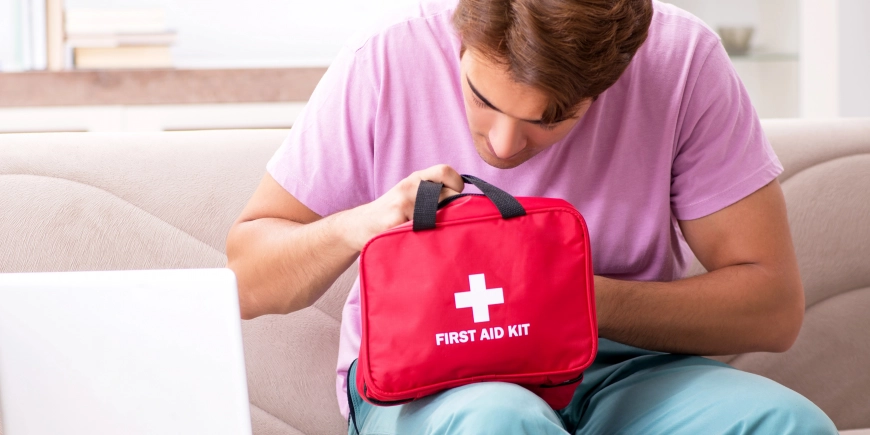
We are very good at this work.
We know how to read a room — and a chart. We know when something is being missed, minimized, or misread. We know how to stay calm in a medical moment, how to ask the right question at the right time, and how to speak up clearly on behalf of the people we serve.
What we are sometimes less prepared for is the moment when we are the patient.
I learned this firsthand recently — not in a hospital, but in my own home. And I want to share it with you, because I suspect I am not alone.
The Incident
I had a confrontation with an animal that left my right hand injured. My dominant hand, naturally.
I knew immediately what to do. I got to the sink, cleaned the wound, and leaned against the counter — not out of preference, but because the room was beginning to tilt. I called out to my husband for help and asked him to bring band-aids.
What followed was illuminating.
He didn't know where the band-aids were.
And because I was using the counter to hold myself upright rather than sitting on the floor, he didn't recognize how urgent the situation was. What looked like composure from across the room was actually me doing everything in my power not to pass out.
He didn't know that.
That is not a criticism of him. It is an honest observation about a gap we didn't know we had — and a gap that I suspect many of our households share.
The Gap We Don't Talk About
Here is what I have been sitting with since that afternoon:
For 35 years, I have been the person who manages the logistics, knows where things are, and stays calm in a medical moment. I have coached families through hospitalizations. I have helped patients articulate urgency to care teams. I have stood in rooms where the stakes were as high as they get, and I have known what to do.
It had simply never occurred to me to prepare my own household for the possibility that I might one day be the one on the wrong side of that equation.
As advocates, we spend our professional energy preparing others. We build frameworks for our clients. We walk patients and families through what to expect, what to ask, and how to respond. We are planners by nature and by training.
And yet — who has planned for us?
What the Incident Revealed
He eventually found the band-aids and helped me to the kitchen table. The bleeding had stopped. But then came the search for first-aid ointment — which I knew I needed, and which was not where either of us thought it was.
By the time I was steady enough to walk on my own, I retrieved the first-aid cream myself, applied it to what turned out to be multiple injuries, and reflected on two things that had just become very clear:
1. Our first-aid kit needed to be better organized. Knowing a kit exists is not the same as knowing where everything in it is. That distinction matters when the seconds count — and it matters even more when the person who normally knows is the one who's hurt.
2. I had never briefed my own household on how to care for me.
As advocates, we understand better than most that effective caregiving requires preparation and clear communication. We teach this. We model it. And yet I had never applied that same standard to my own home — never sat down with my husband and said: «Here is what I would need from you if I were the one who was injured.»
The Communication Gap Is Ours to Close
There is a dimension of this incident that felt particularly relevant to share with this community.
When I called for help, I was managing the wound, managing my response, and managing my own assessment of the situation. What I did not do was clearly communicate urgency.
I assumed my posture communicated it. It did not.
In our advocacy work, we help patients find and use their voice in high-stakes moments. We teach them to say: «This is urgent. I need you to stop and listen.» We help them understand that staying calm does not automatically signal to others that everything is under control — and that sometimes the most important thing a patient can do is use direct, explicit language.
I needed to apply that same teaching to myself. And I didn't — not in that moment.
The words worth practicing, for all of us:
«This is urgent. Stop what you're doing and come now.»
Or, when appropriate: «I need help, but I don't think we need 911. Here is what I need you to do.»
Say the words. Do not assume. Our loved ones and our support networks are not mind readers — even when they love us deeply, and even when they want to help.
The Lighter Side
I want to acknowledge something before I close, because I think it matters.
Of all the injuries on my right hand, one finger came through completely unscathed.
Unfortunately, it is the one finger that — when held up on its own — sends an entirely different message.
I have chosen not to document this on social media, for reasons that will be immediately obvious to anyone who is picturing it right now.
But I will say this: the ability to find humor in a difficult moment is not merely a personality trait. It is, I would argue, a clinical asset. Laughter reduces stress. Reduced stress supports healing. And for those of us in this work — where the weight of what we carry for others can be considerable — humor is also a form of sustainability.
Laugh when you can. It helps. And it models something important for the patients and families who are watching how we navigate hard things.
An Invitation to Reflect
I am writing this for you — my peers — because I believe this gap is worth naming in our community.
We are skilled, experienced, and deeply committed to the people we serve. And we may be, in some cases, the least prepared people in our own households for a medical moment involving ourselves.
A few questions worth sitting with:
- Does your household know where your first-aid supplies are — and what's in them?
- Does your support network know how to recognize urgency in you — not just in your patients?
- Have you ever briefed the people closest to you on what you would need if you were the one who was hurt?
- Do the people in your life know when to call 911 on your behalf — and when you'd want them to wait and assess?
These are the questions I ask families to work through before a hospitalization. I am now asking them of myself — and of you.
One Final Thought
Back to school season will soon be upon us. Households everywhere are recalibrating schedules, routines, and responsibilities. It is, I have found, one of the best natural moments to have practical conversations about preparedness — because everyone is already in the mindset of planning.
If you work with families, consider adding this conversation to the list of things you encourage them to have. And if you have not yet had it in your own home — this is a perfectly good time to start.
We advocate for others every day. Let's make sure someone is prepared to advocate for us.
Val Barschaw is the author of Surviving the Hospital: 6 Secrets Every Patient Should Know (Redemption Press, September 2025) and the founder of hospitaltohealth.com, where a free Hospital Readiness Checklist is available for patients, caregivers, and the advocates who serve them.