

Search by the «virtual» tag
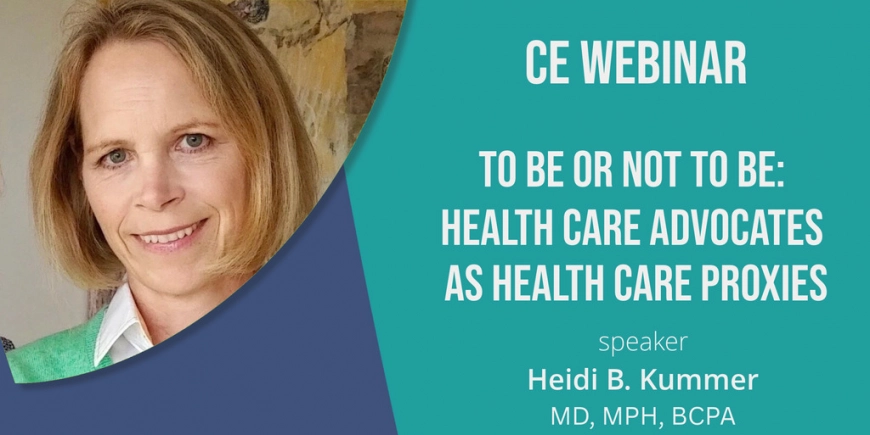
To Be or Not to Be: Health Care Advocates as Health Care Proxies
NAHAC Members & Non-Members
November 17, 2026
3 PM ET | 2 PM CT | 1 PM MT | 12 PM PT
Approved for 1.0 Ethics BCPA CE credit.
🎤 Speaker: Heidi B. Kummer, MD, MPH, BCPA
📘 Description
Professional patient advocates are sometimes asked to serve as health care proxies for their clients—a request that may represent the ultimate extension of the advocate’s commitment to preserving a client’s autonomy, values, and wishes when the client can no longer speak for themselves.
For some clients, particularly Solo Agers or those without an appropriate family member or trusted friend, a professional health care advocate may be the person who best understands their values, wishes, and priorities. Serving in this capacity carries distinct responsibilities and raises important questions about professional boundaries, conflicts of interest, compensation, decision-making authority, and the distinction between advocacy and surrogate decision-making.
This session will examine when serving as a health care proxy may be appropriate, when it may not be, and the safeguards advocates should consider before saying yes.
🎯 Learning Objectives
Differentiate the roles and responsibilities of a professional patient advocate from those of an appointed and activated health care proxy or other surrogate decision-maker.
Identify ethical, legal, and practical considerations that arise when a professional advocate is asked to serve as a client’s health care proxy, including potential conflicts of interest, professional boundaries, compensation, and continuity of care.
Evaluate circumstances in which a professional patient advocate may appropriately serve as a client’s health care proxy, as well as circumstances in which the advocate should decline the role.
Apply practical safeguards to reduce risk and preserve the client’s autonomy, including clear role delineation, separate agreements, documentation of the client’s wishes and values, and advance planning for activation of the proxy role.
👤 About the Speaker
Heidi B. Kummer, MD, MPH, BCPA, serves as President of the Patient Advocate Certification Board (PACB) and is founder and CEO of 3C Patient Advocacy. A physician and bioethicist by training, she has spent much of her career addressing complex medical decision-making, patient autonomy, and the ethical challenges that arise at the intersection of health care and advocacy. She is a nationally recognized leader in the development of professional patient advocacy and has contributed extensively to advancing ethical standards, professional competencies, and recognition of independent patient and health care advocates.
PLEASE NOTE: The Zoom link for accessing this webinar will be included in your registration confirmation and sent again the morning of the event.
Starts Tue Nov 17 2026, 3:00pm EST
Ends Tue Nov 17 2026, 4:00pm EST
Event start date:
15:00
Event end date:
16:00
Time Zone:
ET
 Like
Like
No likes

Advocacy at a Crossroads
Navigating Complexity, Sustainability, and the Future of the Profession
Thursday, November 12, 2026
11:00 a.m. – 5:00 p.m. Eastern
Virtual conference
Join health care advocates from across practice settings for a day of learning and conversation about the challenges facing our profession and the future we can shape together. NAHAC is proud to partner with the Coalition of Health Care Advocacy Organizations (CHCAO), Patient Advocate Certification Board, and HealthAdvocateX for this event.
Continuing education: Five CEUs are available for eligible participation. See CHCAO’s conference page for program and registration details.
Event start date:
11:00
Event end date:
17:00
Time Zone:
ET
Like
Like
No likes
Free Monthly Virtual Sessions
PACC offers a structured, supportive space for learning how to navigate the healthcare system—not for discussing personal medical problems. Through guided conversations and real case examples, participants share practical strategies and gain insight from a wide range of experiences.
These one-hour sessions are held online via Zoom. Participants are expected to use the camera and microphone. Each PACC follows a clear structure and a few essential ground rules to ensure respectful, productive dialogue. For example, unsolicited advice is not allowed. Instead, participants are encouraged to share what has worked for them and allow others to take from it what is useful. If someone asks for advice directly, that’s welcome.
The goal of every PACC session is for participants to walk away with actionable tips and confidence to become better-prepared patients or more effective patient advocates.
Event start date:
19:00
Event end date:
20:00
Time Zone:
ET
Like
Like
No likes

Empowering Independence: Strategies for Successful Aging in Place
Planning for aging in place is not as easy as it might seem. Most people understand and expect changes as they age, including physical strength, mobility, vision, hearing & in some cases, cognition. Yet too few people recognize the impact of these incremental changes in health status. Failing to recognize or ignoring such changes can threaten both independence and well-being, making proactive planning critical to aging in place.
Karen uses real-world case studies to explore how patient advocates can support informed, person-centered decisions around various challenges and risks related to aging in place
Event start date:
19:00
Event end date:
20:00
Time Zone:
ET
Like
Like
No likes