


🧭 Medicare WISeR Model: What Patient Advocates Should Know
🚨 Medicare info for patient and healthcare advocates
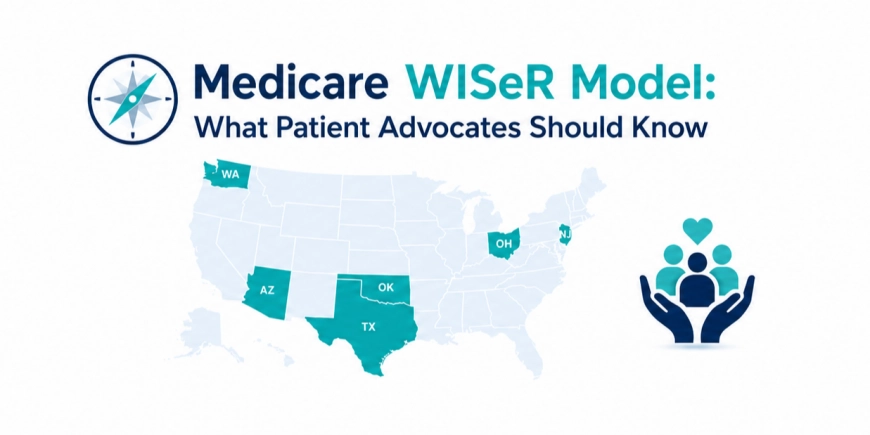
Patient and healthcare advocates working with clients in Arizona, New Jersey, Ohio, Oklahoma, Texas, or Washington:
Have any of your clients with Original Medicare told you that a service was denied, delayed, or suddenly required prior authorization or more documentation?
It may be worth checking if the service is part of Medicare’s WISeR Model.
🔎 What is WISeR?
WISeR stands for Wasteful and Inappropriate Service Reduction.
It is a Medicare model/pilot program that began in January 2026 and applies to selected services under Original Medicare in certain states.
In simple terms, WISeR adds an extra review step before Medicare pays for some services.
This does not apply to every Medicare service, and it does not apply to Medicare Advantage plans.
🩺 Some services that may be affected include:
• Certain pain procedures
• Nerve stimulation procedures
• Knee arthroscopy for osteoarthritis
• Incontinence-related devices
• Sleep-apnea nerve stimulation
• Skin or tissue substitutes for some wounds
⚠️Why should advocates pay attention?
Early reports have raised concerns about delays, denials, and requests for more documentation.
RISE Health reported concerns about high initial denial rates, workflow challenges, and care delays.
(RISE Health: https://www.risehealth.org/insights-articles/another-report-finds-wiser-pilot-causing-longer-delays-higher-costs-and-care-denials/)
U.S. Senator Maria Cantwell from Washington also reported that some providers were waiting 15 to 20 days for determinations, even though CMS expected responses within 72 hours. She also reported that some procedures that previously took about two weeks were taking four to eight weeks after WISeR began.
(U.S. Senator Maria Cantwell: https://www.cantwell.senate.gov/news/press-releases/in-letter-to-rfk-jr-cantwell-demands-changes-to-new-ai-driven-prior-authorization-program-thats-overruling-wa-doctors-and-delaying-care-for-seniors)
🧭 What can advocates do?
If you think a case may be affected by WISeR, start by confirming:
• Does the client have Original Medicare?
• Is the client in one of the WISeR states?
• Is the service included in the WISeR model?
• Was there a denial, delay, request for records, or request for more documentation?
Then, gather the facts:
• Was a WISeR prior authorization submitted?
• Did the provider receive a request for more documentation?
• Is there a denial, non-affirmation, Medicare Summary Notice, or claim notice explaining what happened?
From there, advocates can help organize the information, review the applicable Medicare process, and support the patient in understanding possible next steps.
💙 The goal is not to alarm patients.
The goal is to help them move forward with clearer information, less confusion, and better support.
I’ll continue sharing updates like this as we learn more, with the hope of helping patients, families, and advocates feel more informed and less alone when navigating Medicare.
Learn more from CMS about the WISeR Model:
https://www.cms.gov/priorities/innovation/innovation-models/wiser
 AnnMarie Cross
4 months ago
AnnMarie Cross
4 months ago
 Ron Shinkman
4 months ago
Ron Shinkman
4 months ago